
Developing critical digital skills from within
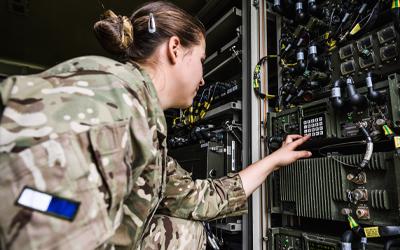
The Open University (OU) has a longstanding relationship with the Ministry of Defence (MoD), providing education for serving and ex-personnel. For the past 20 years, the OU’s School of Computing and Communications has collaborated with the Cisco Networking Academy (NetAcad), incorporating the technology company’s globally recognised IT qualifications into its degree programmes. This partnership enables the OU to provide cutting-edge learning in fields such as cybersecurity and networking.
And for several years now, the OU has run programmes that align with the MoD’s Defence School of Communications Information Systems (DSCIS), allowing them to upskill people in a very competitive talent market and even become instructors themselves in the future. This is critical in a world where cyber threats and networks become ever more important in the nation’s security.
In 2020, the OU remodelled a range of postgraduate courses, creating a postgraduate degree in computing that includes a range of topics, including advanced networking and security. This programme has been very popular within DSCIS, enabling employees to learn vital skills and gain an industry-recognised qualification that advances their careers inside and outside the military.
Learning to teach

“People working in the armed forces can enrol, get the postgraduate certificate and get the industry accreditation and recognition. Our courses are very applied – not just theoretical – which makes them very applicable to job roles,” says Andrew Smith, Senior Lecturer in Networking at the OU’s School of Computing and Communications. “Associate lecturers have also been able to do this, getting the teaching qualifications they need to work with their own students within their own disciplines. It’s a clever double win.”
Many of the MoD’s instructors have since studied at postgraduate level through the OU. Andy Horsley, Higher Specialist Instructional Officer at the MoD’s DSCIS, says the programme dovetails nicely with the existing instructor accreditation provided through NetAcad. “We have been able to use it to train our instructors up to a level where they could teach this stuff, with the added benefit that if they wanted to pursue a full Master’s degree, they could add modules on to it.”
Industry-recognised learning
It is critically important that armed forces personnel can access industry-recognised qualifications so that their skills and experiences are transferable when they leave the MoD. Smith says the OU-MoD partnership enables that.
The real benefit is the marriage between what we do and that academic professional accreditation journey so that when they leave the armed forces, then can take what they’re already doing and be able to do it outside. It’s that lifelong learning journey.
Andrew Smith Senior Lecturer in Networking, Open University, School of Computing and Communications
Service personnel that have worked in the military for a minimum of six years can access enhanced learning credits, which they can put towards qualifications or training courses at Level 3 or above (England, Northern Ireland and Wales) or at Level 6 and above in Scotland. Horsley says many have opted to use their enhanced learning credits to go down the Cisco certification pathway.
And some of them have gone on to extraordinary levels with their learning from that. It would be very expensive for the MoD to hire people with the requisite skills in disciplines such as networking and cybersecurity, so it is vital that the skills are developed in-house instead.
Andy Horsley Higher Specialist Instructional Officer, Ministry of Defence, Defence School of Communications Information Systems
Horsley started his Cisco learning eight years ago and soon realised that he wanted to teach others at the MoD. He has benefited hugely from the programme, gaining his MSc and the skills and accreditation to instruct others. “It gave me that teaching qualification, which has opened doors for me within my career – I’m the academic lead now and it gave me the opportunity to take that role on.”
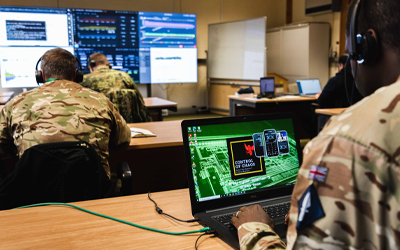
He says the modules were highly relevant and practical, enabling him to apply his learning and embed it in real time.
According to Viki Little, Business Development Manager at the OU, each year roughly 800 MoD personnel register to study with the OU, mainly through the enhanced learning credits programme (as well as other funding sources). This is a mix of serving staff and those who have recently left the armed forces and re-joined civilian life (there is a three-year grace period to spend the credits). “The enhanced learning scheme is really important and the OU is a well-established option for those looking for flexible education around other responsibilities.” she says.
Smith added: The relationship between DSCIS and the OU has progressed with the university invited to be part of an industry advisory panel for DSCIS and be part of a pan-NATO working group with Cisco as we grow our role in providing the digital skills needed in today’s world.”
Discover practical ways to close digital skills gaps and build a workforce ready for digital transformation:
Explore digital skills solutionsDiscover how NetAcad builds in-demand digital skills:
Explore NetAcadPlease contact us to speak to one of our business team advisors.
Not on our mailing list?
Sign up to receive regular emails that are full of advice and resources to support staff development in your organisation.


Explore

Undergraduate
Postgraduate
Policy
-
Follow us on Social media
-


