
Navigating the digital skills landscape: Insights from our recent webinar
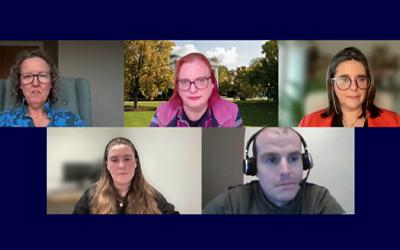
Employers across various sectors are grappling with the same challenge: demand for specialist digital capabilities is accelerating and evolving faster than organisations can recruit them. In our recent webinar, leaders from The Open University (OU), local government, and the tech industry shared valuable insights on building future ready digital teams, all while navigating the AI revolution, talent shortages and shifting expectations of early career professionals.
Panel
- Lorna Willis, CEO, TechSkills (Host)
- Jill Shaw, Director of Teaching – STEM, Computing and Communications, The Open University
- Autumn Thomson, Senior Lecturer and Staff Tutor in Computing and Communications, The Open University
- Phoebe Chapman, Senior Software Engineer, RDT
- Jon Evans, Senior Manager, Digital Services, Powys County Council
The shape of the skills gap
TechSkills CEO Lorna Willis opened by acknowledging the speed of change and the struggle to keep up. AI, cyber, software and data skills dominate employer wish lists, yet entry level recruitment has declined. Organisations face a paradox: they need more digital specialists, but traditional early career pipelines are shrinking as tasks are automated.
For Jon Evans of Powys County Council, the challenge is particularly acute outside major cities. With rurally based organisations competing for the same limited pool of talent, the council shifted strategy entirely. “We made a very intentional move to grow our own,” he explained.
Investing in early talent
Both the council and RDT have seen strong returns from developing talent internally. Phoebe Chapman, who joined RDT as a degree apprentice and is now a Senior Software Engineer, described apprenticeships as a win–win for learners and employers.
Phoebe also highlighted how giving apprentices early exposure to AI tools boosts both confidence and contribution. “It gives them like a little assistant … and it brings in a fresh perspective that might make us question whether the way we’re writing things now is as efficient as it could be.”
Lorna added: What we’ve found when we talk to other employers and within TechSkills, is that the world has changed. When I was coming up through the ranks, my job was to learn from my manager. So, I replicated what they did. That's what success looked like. And actually, I was expected to do the same as they did in the same way that they did.
Now, what we're finding is that entries, early careers and apprentices going into the organisation are expected to have a set of skills and a voice that’s going to have an impact on that organisation.
Lorna Willis CEO, TechSkills
Workforce planning for an AI driven future
Employers often attempt to buy in scarce expertise when urgent needs arise, but Autumn Thomson cautioned against relying on short term fixes.
“Hiring someone in can be really challenging. If it’s a contractor they don’t know your organisation. If you’re going away to go and find somebody as a full-time employee, they might not be able to start straight away … they don't have any organisational knowledge. They might have used tools and techniques in a different way, in a different place.”
Meanwhile, AI is reshaping job design and reducing some traditional entry level tasks. OU’s Jill Shaw stressed the growing importance of transferable cognitive skills, citing DeepMind’s CEO:
Learning to learn is the most crucial skill for the future … We [at the OU] have been really focusing on those professional skills of critical thinking, communication skills and reflective skills, being ready to learn.
Jill Shaw Director of Teaching – STEM, Computing and Communications, The Open University
This ethos underpins the OU’s new digital degree and apprenticeship programmes, designed not just to teach the latest tools—but to develop adaptable thinkers who can thrive as technology evolves.
AI’s impact on roles and teams
While headlines often focus on the disappearance of job roles, panellists highlighted the positive impact of AI on service quality and job satisfaction. Jon explained that Powys County Council is using AI to give staff more time with customers and service users, rather than to reduce headcount. Phoebe echoed this benefit in the private sector, noting that AI streamlines coding tasks so teams can focus on collaboration and problem solving.
Building flexible, future-ready learning pathways
A recurring theme was the power of flexible, work based learning. Without a local university in the region, Powys County Council relies heavily on the OU's online-first, supported part time model to maintain service levels and user satisfaction.
OU programmes, such as the new suite of digital apprenticeships available in England and Wales, now blend foundational knowledge, applied learning and work based projects, helping organisations embed learning in day to day delivery and see return on investment faster.
OU apprenticeships mentioned in the webinar
The webinar referenced several apprenticeship pathways available through the OU:
Level 4 apprenticeships (England)
Level 6 apprenticeship (England)
- Digital and Technology Solutions Professional Degree Apprenticeship
Specialise in software development, cyber security, data analysis or network engineering.
Level 6 apprenticeship (Wales)
- Digital Degree Apprenticeship
Specialise in data science, cyber security management or software engineering.
About TechSkills
TechSkills brings together employers and educators to create industry-valued pathways into digital careers. A not-for-profit organisation, techskills is responsible for Tech Industry Gold, the employer-led accreditation recognising high-quality education across degrees, apprenticeships, and training programmes.
TechSkills plays a key role in closing the digital skills gap by aligning sector needs with education provision, enabling learners to progress into the workforce with industry-ready skills.
Please contact us to speak to one of our business team advisors.
Not on our mailing list?
Sign up to receive regular emails that are full of advice and resources to support staff development in your organisation.


Explore

Undergraduate
Postgraduate
Policy
-
Follow us on Social media
-


