
Network Engineer Higher Apprenticeship
Certificate of Higher Education
Download brochure Get started
Level 4 Network Engineer Higher Apprenticeship
The Level 4 Network Engineer Higher Apprenticeship is designed to equip learners with the knowledge, skills and behaviours needed for a career as a computer network engineer.
Network engineering apprentices will:
- Receive comprehensive training and hands-on experience in configuring, managing, securing, and troubleshooting network systems, covering both hardware and software aspects.
- Learn how to effectively handle complex network environments across diverse industry sectors to prepare them for a successful career as a network engineer.
- Open up career progression pathways to a Level 6 Digital and Technology Solutions Professional apprenticeship with the OU.
Level: Apprenticeship Level 4 Network Engineer
Looking for something more advanced? Check out our degree-level Digital and Technology Solutions Professional Apprenticeship
Study method: Online/work-based learning with tutor support
Duration: 12 months, followed by an end-point assessment (typically 3–6 months)
Funding: See fees & funding
Entry requirements: See entry requirements
Available in: England only
This programme is designed for individuals who want to progress their careers in network engineering.
- The structure of the programme supports apprentices to grow and develop their own digital careers.
- The programme is available to existing employees for career progression and skills development, as well as for hiring new talent and growing your team.
- Ideal for employers across all industries — from private enterprises to NHS Trusts, councils and central government — looking to fill digital skills gaps and future-proof their workforce.
You don’t need formal qualifications to start this programme, but apprentices must be employed in a relevant role with an organisation willing to support them through the apprenticeship.
To be eligible for government funding, apprentices must:
- Be aged 16 or over
- Not be in full-time education
- Not already be on another apprenticeship
- Have the right to live and work in England
- Spend at least 50% of their working hours in England
This programme is ideal for those aiming to build a career as a Network Engineer, with the potential to develop into a cyber security analyst with further study. For more information, check out the 'Who is it for?' section above.
Looking for a degree apprenticeship? Check out our Level 6 Digital and Technology Solutions Professional Apprenticeship.
Upon successful completion of the programme, apprentices will be awarded:
- Certificate of Higher Education - Network Engineer, by The Open University.
- Network Engineer Apprenticeship, by Department for Education.
- English and maths functional skills qualifications at Level 2 if required, as outlined below:
- For apprentices under 19 when they begin their apprenticeship training, English and/or maths is a mandatory part of the programme if not previously achieved and evidenced.
- For apprentices aged 19+ when they begin their apprenticeship training, the employer may make it a mandatory requirement to complete English and/or maths during their Apprenticeship if not previously achieved and evidenced.

Digital learning pathways
At The Open University, we offer two pathways into our digital apprenticeship programmes, giving apprentices and employers the flexibility to choose the right starting point.
Find the pathway that fits your goals.
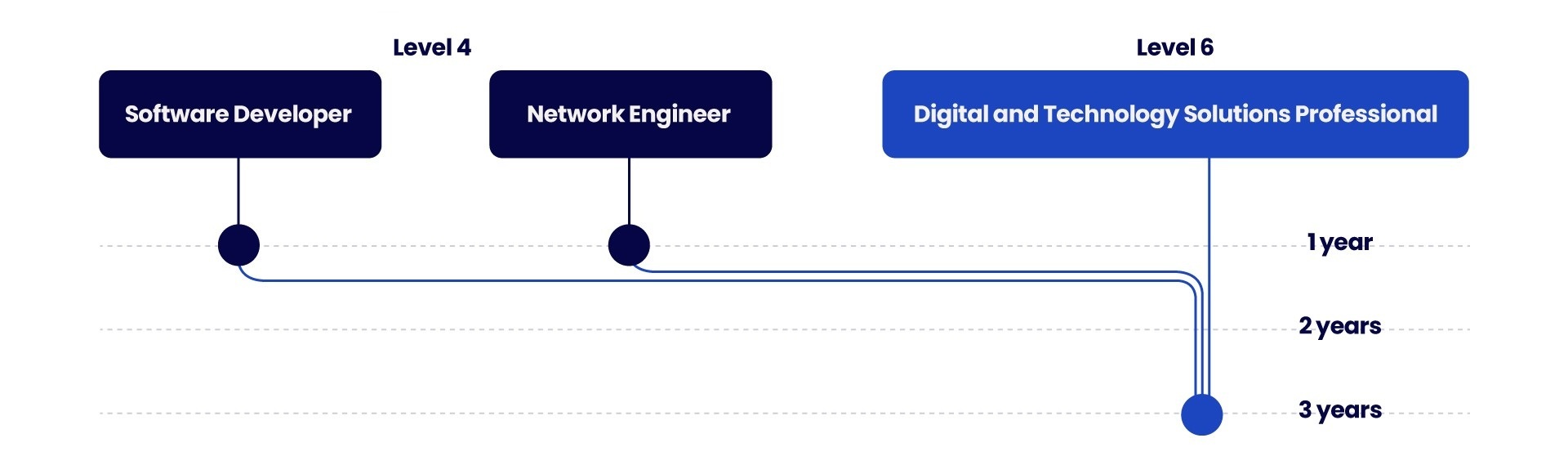
Step 1: Start with a Level 4 apprenticeship
Programme: Network Engineer
Ideal for: Gaining a solid foundation and testing your interest in networking
Duration: 12 months, followed by an end-point assessment (typically 3–6 months)
Learner benefits:
- Develop essential digital skills and hands-on experience
- Learn while you earn in a supportive environment
Organisation benefits:
- Low-risk way to nurture new talent
- Build confidence and capability in early-stage learners
On successful completion, apprentices can choose to finish at this stage or progress directly to the Level 6 degree apprenticeship*, specialising as a Network Engineer or Cyber Security Analyst. Those continuing will join at Stage 2 and complete their studies in a further two years. We expect step 2 to be available from Autumn 2027.
Step 2: Progress to stage 2 of the Level 6 apprenticeship
Programme: Digital and Technology Solutions Professional
Ideal for: Learners ready to deepen their expertise and take on more responsibility
Duration: 2 years
Learner benefits:
- Gain specialist knowledge and professional behaviours
- Build career momentum
Organisation benefits:
- Retain and develop skilled digital professionals
- Drive productivity, innovation and leadership in your workforce
Direct entry into the Level 6 Digital Apprenticeship
Programme: Digital and Technology Solutions Professional
Ideal for: Learners with existing experience seeking a faster route to advanced skills
Duration: 3 years (including the end-point assessment)
Learner benefits:
- Focus on your specialism: Start your journey as a Network Engineer in year 1 and build toward your chosen specialism in year 2, whether that’s Network Engineer or Cyber Security Analyst
- Advance to specialist or leadership positions
Organisation benefits:
- Retain and develop skilled digital professionals
- Drive productivity, innovation, and leadership in your workforce
- Shape the digital specialists your organisation needs
Academic excellence
This apprenticeship is built from the ground up to meet the needs of today’s workplace. Every module has been created by our world-class academics specifically for this apprenticeship, so you can be confident the learning is current, industry-relevant and designed to deliver impact from day one.
With more than 50 years of expertise in distance education and a worldwide reputation for flexible learning, The Open University is a leader in developing apprenticeships that combine rigour with real-world relevance.
Our reputation for quality is nationally recognised:

University of the Year 2025

Gold-rated Teaching Excellence Framework

Exceptional student satisfaction (NSS, 2025)
Teaching (92.8%), organisation (90%), and assessment and feedback (89.2%)

Ofsted rated 'Good', 2025
Programme information
This apprenticeship blends academic learning with real-world application, enabling apprentices to develop skills that deliver immediate impact in the workplace — from study and communication skills to independent working and professional employability.
Apprentices complete two 60-credit modules:
- Digital Foundations: This module introduces apprentices to essential foundational concepts within their specialism, while also supporting their transition into apprenticeship life at The Open University. It fosters the development of core knowledge and skills while providing an initial opportunity to balance work and study laying the groundwork for sustained success throughout the apprenticeship programme.
- Digital Work Based Practice 1: This module supports the practical application of learning from the Digital Foundations module, while initiating portfolio development for the end-point assessment. Employers play a key role by assigning a live project, enabling apprentices to generate business impact and demonstrate their value in real-world settings.
From the start, the focus is on practical, hands-on tasks that support apprentices in contributing to their organisation while gaining confidence and competence in their technical and professional skills.
We regularly review our curriculum; therefore, the qualification described on this page – including its availability, its structure, and available modules – may change over time. If we make changes to this qualification, we’ll update this page as soon as possible. Once you’ve registered or are studying this qualification, where practicable, we’ll inform you in good time of any upcoming changes. If you’d like to know more about the circumstances in which the University might make changes to the curriculum, see our Academic Regulations or contact us. This description was last updated on 24/10/2025.
Want to know more?
For more details about each module and how they are assessed, download the programme brochure.
Study structure
The Open University is a global leader in flexible, work-based learning with over 50 years’ experience in distance education. Our approach allows apprentices to balance study with their job while delivering immediate impact in the workplace.
- Anytime, anywhere learning: access content 24/7 on laptops, tablets or mobiles.
- Tutor support and peer learning: online tutorials, forums and discussion groups connect apprentices with expert tutors and industry peers.
- Employer-friendly delivery: our flexible model makes off-the-job training easier to manage with minimal disruption to productivity.
Each module is supported by a dedicated online platform with:
- A week-by-week study planner, giving you a step-by-step guide through your studies
- Course materials such as reading, videos, recordings, and self-assessed activities
- Module forums for discussions and collaborative activities with other students
- Details of each assignment and their due dates
- A tutorial booking system, online tutorial rooms, and your tutor’s contact details
- Online versions of some printed module materials and resources.
If you have additional needs, we can also provide most module materials in alternative formats. Find out more about materials on our accessibility webpage.
Assessment and feedback
- Modules will be assessed through a range of remote methods such as interactive computer marked assignments and tutor marked assignments during and at the end of each module.
- Work based learning will be assessed through the portfolio of evidence related to the knowledge, skills and behaviours in the apprenticeship standard developed throughout each module.
- Feedback will be given through tutorials, self-assessment, peer review, and during progress reviews with the University and your workplace mentor.
- When your period of study and work base learning has ended, all apprenticeships are assessed via an end-point assessment (EPA) process at the end of your apprenticeship. For more information about the EPA, please refer to the EPA plan here.
All assessments will be carried out remotely with minimal disruption to business.
Workload and off-the-job training
Apprenticeships combine full-time employment with structured training that meets the requirements of the Apprenticeship Standard (in England). In England, this is called ‘off-the-job training’ (OTJT) – which is the time set aside during contracted working hours to study with The Open University.
The OTJT hours will typically be around one day a week or 20% of contracted hours, subject to the Skills Radar. The Skills Radar is part of the initial assessment and is a mandatory systematic review of an apprentice’s knowledge, skills and behaviours against the standard before commencing the programme. This will be completed jointly by the apprentice and the line manager to establish the apprentice’s baseline against the standard and how much new learning is needed.
Employers are required to provide extra off-the-job training time if functional skills qualifications need to be completed during the programme.
Want to know more?
For more details about each module and how they are assessed, download the programme brochure.
Employers
Employers are responsible for paying their apprentices' salaries, but training costs can be funded through the Growth and Skills Levy or part-funded through Government funding. The funding method for an apprenticeship is determined at the start of each apprentice’s programme.
Growth and Skills Levy
- Employers with a payroll of more than £3 million can use their Growth and Skills Levy contributions to pay for places on apprenticeship programmes.
- Any business with a payroll below £3 million is eligible for government funding that will cover at least 95% of the cost of an apprenticeship course.
- Additional incentives are also available to employers who recruit new apprentices into their business.
Additional costs may apply, for example, if apprentices need to undertake resits.
For more information about funding, get in touch with us.
Apprentices
- There are no fees to pay for apprentices as the funding is covered by employers.
At The Open University, we know that successful apprenticeships depend on the right support. Alongside expert tutors, apprentices and employers benefit from:
- A dedicated account management team
- Specialist staff who work collaboratively with managers and mentors in your organisation
- Comprehensive onboarding and ongoing support throughout the apprenticeship journey
Learn more about how The Open University supports apprentices
When you're ready to begin the apprenticeship application process, there are a few simple steps for both employers and apprentices. Our team is here to support you at every stage to ensure a smooth and efficient onboarding experience.
For employers
Initial contact
Reach out to us to express your interest in the apprenticeship programme.
Programme consultation
One of our dedicated Account Managers will contact you to discuss your organisation’s needs and the programme details.
Confirmation and paperwork
Once you confirm you'd like to proceed, we’ll guide you through the necessary documentation.
Submit apprentice details
Provide us with the names and contact information of your chosen apprentice(s).
Apprentice is contacted by the OU and invited to apply
We will also invite the employer to apply for the apprenticeship.
Contracting
Employer engages in discussions around the apprenticeship. Agreements and documentation are signed by the OU, the employer, and the apprentice before confirmation.
For more information for employers, please see the following resources:
For apprentices
Initial contact
Ask your employer to get in touch with us to start the process.
Invitation to apply
Once the employer process is complete, we will invite you to apply via our online onboarding platform.
Submit evidence and application
Prepare and upload any required documents to verify your eligibility and complete your application.
Decision
The OU will review your application and inform you whether you’ve been offered a place.
Meet your programme manager
As part of onboarding, you’ll be introduced to your Apprenticeship Programme Delivery Manager (APDM), who will support you throughout the programme.
Contracting
Apprenticeship agreements and documentation are signed by the OU, the employer, and the apprentice before the programme begins.
Begin pre-study
Once successfully registered, you’ll gain access to pre-study materials to help you prepare for the course.
For more information about apprenticeships and being an apprentice, please see Information for apprentices.
For further details, please see the following resources:
- Apprenticeship standard: The apprenticeship standard defines the specific skills, knowledge, and behaviours (KSBs) an apprentice must acquire to succeed in a particular job role. It also gives more details about the funding and apprenticeship assessment plan.
- Qualification descriptor: This provides more detail about the programme, specific modules, including teaching and assessment methods. This document was last updated on 02 March 2026.
- Qualification regulations: You should be aware of these qualification-specific regulations in addition to the academic regulations (Apprentices).
- Quality and Governance: Information related to the Open University's apprenticeship Quality and Governance policy.
- Recognition of Prior Learning (RPL): You may be able to use relevant previous learning to reduce the length of the programme. Find out more about Recognition of Prior Learning (RPL) by contacting us today.
Next steps
For employers
- Download the brochure: Get the full details of our programme, including structure, support, and outcomes - perfect for sharing with internal stakeholders.
- Get in touch with our dedicated team: Click the button below to get in touch and discover how our apprenticeships can support your organisation’s growth and talent development goals.
For apprentices
- Already supported? Great! Share this page with your employer and ask them to get in touch with us here.
- Employed but not yet sponsored? Take the first step by reviewing our guide on how to approach your employer about apprenticeship opportunities.
- Looking for an employer? Visit the government’s apprenticeship website to find current vacancies, or explore our degree programmes to see where your learning journey could begin.
* A direct entry route into Stage 2 of our Level 6 Digital & Technology Solutions Professional Apprenticeship will be available from Autumn 2027 for individuals who have already completed an equivalent Level 4 qualification or apprenticeship elsewhere, subject to a review of your prior learning. We’re currently welcoming enquiries about this route — please get in touch to explore your options.
Frequently asked questions
A Network Engineer is an IT professional who designs, implements, manages and troubleshoots computer networks to ensure that data and communication flow efficiently and securely across an organisation’s infrastructure.
In short, a Network Engineer ensures that all devices, applications, and users can communicate reliably and securely over a company’s network.
To apply for an apprenticeship programme you should be employed in a relevant role and have the approval of your employer.
Read our guidance about getting your employer's support here.
As leaders in supported online learning, the Open University has developed best-practice digital learning platforms. Apprentices will learn online and be supported with digital calls and meetings from their support team.
You may be able to use relevant previous learning to reduce the length of the programme. Find out more about Recognition of Prior Learning (RPL) by contacting us today.
To complete the programme, apprentices will need:
- Internet access and an internet-enabled device (desktop or laptop recommended)
- Webcam and microphone for online tutorials (a wired headset is recommended)
Where additional software is required, we provide access or free alternatives.
Where technical tools are used, we will provide access via the The OpenComputing Laboratory | Faculty of Science, Technology, Engineering & Mathematics, where apprentices can access online computing environments for data analysis and programming through their web browser.
For full details on device requirements for this programme, contact our helpful team.


Explore

Undergraduate
Postgraduate
Policy
-
Follow us on Social media
-


