
Employer webinar: Making the case for leadership education
In today’s challenging organisational landscape, where workforce expectations, technology, regulation and economic pressures are shifting faster than ever, HR and L&D teams are under increasing pressure to justify investment in leadership development.
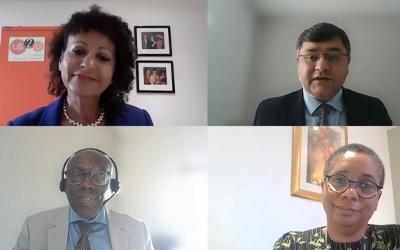
This webinar, hosted by US2U Consulting founder Rachel Blackburn MBE with expert contributors from The Open University and third sector, offers a practical framework for making the business case for leadership education, including MBAs.
Leadership capability as a strategic workforce requirement
Dr Aqueel Wahga, MBA Programme Director, opened by emphasising that leadership education is no longer optional for sustainable organisational performance. Leaders now operate in environments shaped by digital disruption, changing stakeholder expectations and global instability. As he put it:
Aqueel explained: “Training future proofs the organisation… helping leaders navigate complex challenges with evidence based decision-making.” For HR and L&D teams, this reinforces the need to view leadership capability as a core workforce asset rather than a discretionary cost.
Case studies: How education accelerates careers and strengthens organisations
Personal stories from the panel demonstrated the tangible career and organisational gains from leadership education.
- Rachel Blackburn linked her OU MBA directly to founding and scaling her consultancy: “I built the business around the four planks of what I studied… it’s stood us in good stead for 20 years.”
- Susan Hamilton, CEO of St Peter’s Hospice, found the OU MBA filled critical capability gaps as she moved between sectors: “I needed more formal leadership and management training… the MBA gave me immediate skills in finance, marketing and strategy that I wouldn’t have gained otherwise.”
Dr Fidèle Mutwarasibo, Associate Head of Open University Business School - External Engagement used also postgraduate study to strengthen confidence and credibility after stepping into senior roles: “I went back to study to legitimise my expertise… to feel I deserved to be in that space.”
For L&D teams and aspiring leaders, these experiences help demonstrate ROI beyond the purely financial—supporting retention, mobility, performance and organisational agility.
The risk of accidental leaders—and why HR must intervene
A recurring theme was the organisational cost of promoting technically strong performers without development. Rachel highlighted the “lose lose situation” where high performers become overwhelmed when promoted without support, leading to stress, underperformance and often exit.
Aqueel reinforced that accidental leaders can contribute to “high turnover… toxic environments… and poor decision-making.”
For HR, this emphasises the value of structured talent pipelines, proactive identification and targeted learning interventions to ensure succession planning.
Identifying future leaders—without missing hidden talent
Both Fidèle and Susan stressed the risks of relying on informal selection:
- Fidèle described creating paid internships to bring minority candidates into leadership pathways, noting that one intern he supported is now a CEO.
- Susan highlighted the need to recognise “introverted leaders” who are often overlooked in favour of louder, more assertive personalities.
HR’s role is clear: ensure systematic, fair, data driven approaches to talent identification, drawing on performance data, psychometrics, career aspirations and cultural fit.
Building an evidence based business case for development funding
For HR professionals making budget submissions, the panel offered practical guidance:
- Fidèle cited data linking investment in people to measurable reductions in turnover and absenteeism. One organisation he worked with estimated the cost of losing a single trained employee at £80,000.
- Susan emphasised the importance of linking development proposals to organisational objectives, productivity gains and retention risks: “What is the risk of not investing in this team or individual?”
HR and L&D teams should frame investment as a risk mitigation and value creation activity—not a discretionary spend.
Why the OU MBA works for busy, working professionals
The Open University’s flexible online-first MBA supports workforce development without disrupting operations. Aqueel noted:
- Triple accredited Business School gives employers confidence.
- Practice based learning means learners immediately apply skills at work.
- Distance learning enables flexibility around job demands.
- Modular fee structures make budgeting easier.
- A global alumni network (28,000+) enhances organisational connectivity.
Rachel reinforced the practical application benefit: “You can learn the theory one week and apply it with your team the next… the organisation sees the return on investment straight away.”
Watch the webinar on demand and contact us if you would like to discuss how The Open University can help with your leadership education strategy.
Please contact us to speak to one of our business team advisors.
Not on our mailing list?
Sign up to receive regular emails that are full of advice and resources to support staff development in your organisation.


Explore

Undergraduate
Postgraduate
Policy
-
Follow us on Social media
-


