
Does your organisation really listen when employees raise environmental ideas?

By Victoria Nightingale, PhD Researcher, Faculty of Business and Law.
Employees are already noticing. They see the waste created by everyday processes, the travel that could have been avoided, or suppliers whose practices do not quite align with organisational values. They may raise this in a meeting, mention it to a manager, or quietly let it drop when nothing seems to happen.
This is environmental voice and it is happening in organisations whether or not they are designed to hear it.
Most organisations now articulate sustainability commitments through Net Zero targets, ESG reporting, or environmental policies. What receives far less attention is how environmental ideas actually surface in everyday organisational life, and what happens once they are voiced. That gap matters for people practice.
Research increasingly highlights employee participation and voice as central to the success of sustainability initiatives, yet these processes remain under examined within HR, L&D and OD (Paulet, Holland and Bratton, 2021; Boiral and Paillé, 2012). Environmental voice rarely arrives neatly through formal channels. More often, it surfaces informally, tentatively, and unevenly, shaped by organisational culture, relationships and expectations.
What is environmental voice?
Environmental voice refers to employees raising ideas, concerns or suggestions about environmental or sustainability issues at work. These may relate to practical matters such as waste, energy use, travel or suppliers, or to broader questions about environmental impact and organisational commitments.
Importantly, these ideas are not usually framed as “environmental initiatives”. Research shows that environmental voice tends to emerge through ordinary work conversations rather than formal sustainability mechanisms (Boiral, 2009). A comment in a meeting, an informal conversation with HR, or a tentative email to a manager can all constitute environmental voice.
Recent longitudinal research suggests that environmental voice plays a significant role in shaping both employee attitudes and organisational climate around sustainability, even when the voice itself is informal or discretionary - meaning that ignoring it carries real, if often invisible, costs (Eichberger et al., 2025).
Two ways environmental voice tends to appear
In practice, environmental voice often appears in two overlapping forms: compliance oriented and voluntary or discretionary.
Compliance oriented environmental voice is linked to formal organisational frameworks such as Net Zero commitments, ESG reporting requirements, or environmental policies covering travel and procurement. In these contexts, speaking up may feel structured and expected, with clearer routes for escalation and accountability. This form of voice is particularly common in regulated or high visibility organisations, where sustainability is closely tied to external scrutiny and reputation (Moreira, Rodrigues and Ferreira, 2025).
Alongside this sits voluntary environmental voice. This emerges from individual concern or values rather than formal requirement. It is often informal, not written into roles, and reliant on champions. Research on organisational citizenship behaviours highlights that these discretionary contributions are critical to embedding sustainability into everyday organisational life and yet are also vulnerable to being overlooked or unevenly supported (Boiral and Paillé, 2012; Lee, 2025).
Most organisations experience both forms at the same time. The issue is not whether environmental voice exists, but whether the organisation is set up to recognise, legitimise and respond to it.
Why people practice matters
Across my research conversations, HR, L&D and OD practitioners rarely describe themselves as the originators of environmental ideas. Instead, they occupy a critical position in shaping what happens next. Employee voice has been described as a “missing factor” in translating sustainability commitments into lived organisational practice (Paulet et al., 2021). HR often acts as an interpreter between operational concerns and organisational narratives, influencing whether environmental voice is framed as engagement, innovation, risk or noise. Decisions about acknowledgement, feedback and follow up send powerful signals about whether speaking up is worthwhile.
L&D can legitimise sustainability as a topic of professional learning, giving employees the language and confidence to connect environmental concerns to their roles. From an OD perspective, environmental voice often reveals deeper organisational tensions, particularly between short term performance pressures and longer term sustainability ambitions.
Making environmental voice visible
One challenge with environmental voice is that it can remain hard to see. Ideas surface in fragments across teams and levels, raised by individuals who may not know where those ideas belong. Research on employee voice consistently shows that when concerns are ignored, delayed or only symbolically acknowledged, willingness to speak up diminishes over time (Mori et al., 2022).
People practice adds value when it notices patterns across apparently isolated concerns, connects conversations across roles, and helps surface competing priorities without placing blame on individuals. Shifting the question from “who is blocking this?” to “what organisational structures are shaping this response?” allows environmental voice to become a source of organisational learning rather than frustration.
Why this matters beyond sustainability
Environmental voice intersects directly with trust, engagement and organisational credibility. When environmental ideas are raised and go nowhere, employees may conclude that sustainability commitments are primarily aimed at external audiences. When ideas are acknowledged, responded to and, where possible, acted upon, the signal is very different.
Small design choices make a real difference: who owns the response to environmental suggestions, how feedback is communicated, and whether sustainability is visible in people systems rather than confined to policy documents. These are everyday people practice decisions and they add up.
About the research and how to get involved
This article draws on ongoing doctoral research at The Open University, exploring how environmental and sustainability ideas are raised, interpreted and responded to within organisations.
The study is based on confidential interviews with professionals who encounter environmental voice in practice - including HR, L&D and OD practitioners, sustainability and ESG leads, managers, and others who shape how environmental issues are handled at work.
If your role involves responding to environmental ideas, designing people systems, influencing sustainability practice, or navigating tensions between organisational priorities and environmental concerns, you may be well placed to contribute.
Participation involves a one-off, confidential interview, and all contributions are fully anonymised. Further details are available via the research information sheet, or by connecting with the author on LinkedIn.
LinkedIn Email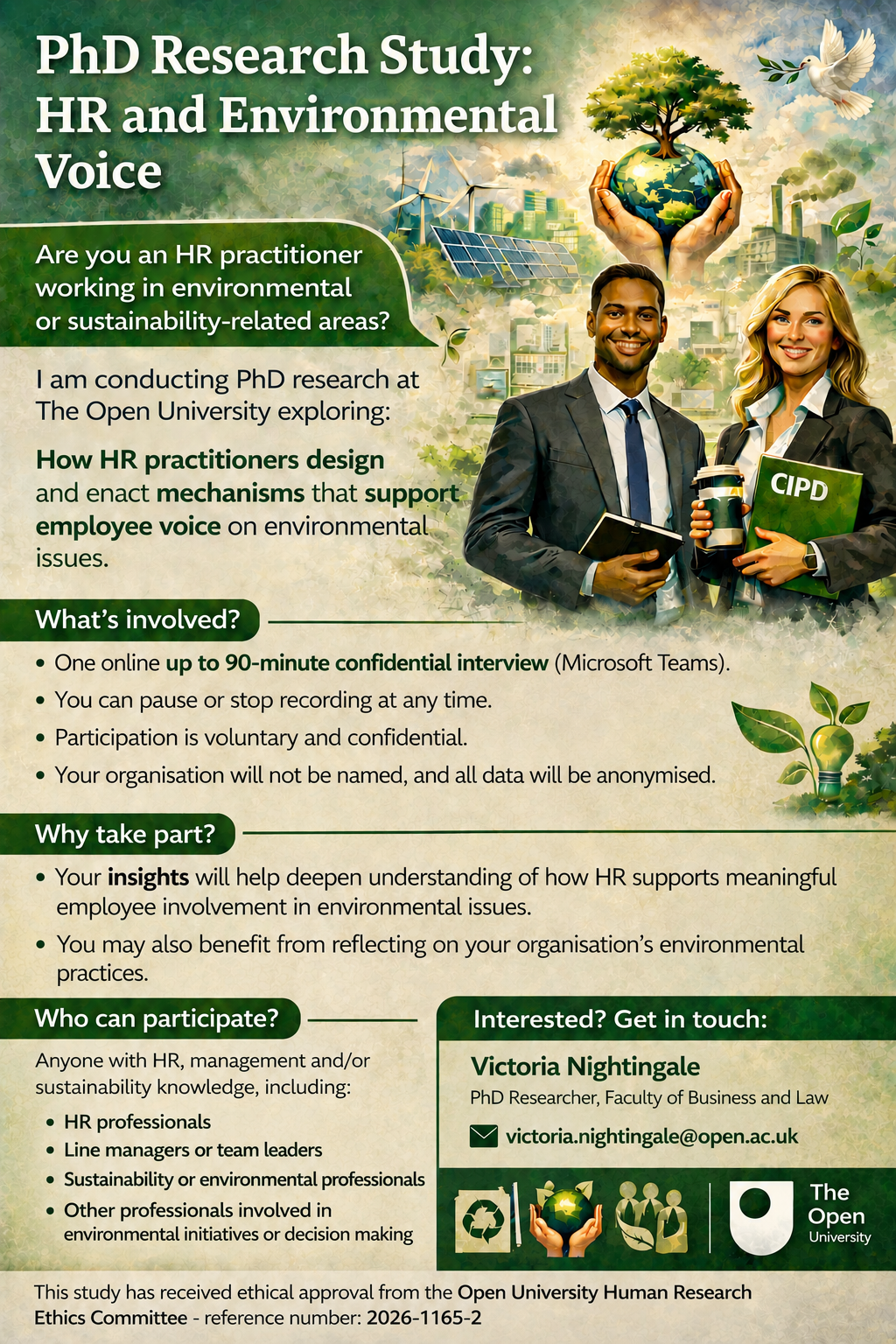
References
- Boiral, O. (2009) ‘Greening the corporation through organizational citizenship behaviours’, Journal of Business Ethics, 87(2), pp. 221–236.
- Boiral, O. and Paillé, P. (2012) ‘Organizational citizenship behaviour for the environment: Measurement and validation’, Journal of Business Ethics, 109(4), pp. 431–445.
- Eichberger, C., Stein, M., Zacher, H. and Weiss, M. (2025) ‘Employee environmental voice shapes environmental attitudes and green organizational climate’, Journal of Environmental Psychology, 107, 102756.
- Lee, J.W. (2025) ‘Sustaining organizations through harmonized civic and employee identities’, Sustainability, 17(11), 4762.
- Moreira, A., Rodrigues, A.C. and Ferreira, M.R. (2025) ‘Where is human resource management in sustainability reporting? ESG and GRI perspectives’, Sustainability, 17(7), 3033.
- Mori, M., Cavaliere, V., Sassetti, S. and Caputo, A. (2022) ‘Employee voice: A knowledge map to provide conceptual clarity and future research directions’, Journal of Management & Organization, 30(6), pp. 1873–1899.
- Paulet, R., Holland, P. and Bratton, A. (2021) ‘Employee voice: The missing factor in sustainable HRM?’, Sustainability, 13(17), 9732.
Please contact us to speak to one of our business team advisors.
Not on our mailing list?
Sign up to receive regular emails that are full of advice and resources to support staff development in your organisation.


Explore

Undergraduate
Postgraduate
Policy
-
Follow us on Social media
-


